Since the Community Reinvestment Program opened this summer, Pierce County organizations have submitted 84 applications for violence prevention funding. Fifty of those applications arrived in time for Round 1, and every one of them went through the same two-phase review.
How Round 1 was reviewed
01
Conflict screen
Before reading an application, each reviewer completed a conflict-of-interest screen, and anyone with a conflict stepped aside.
02
Phase 1: the application
Two independent reviewers scored each application against a shared rubric: alignment with the program’s priorities, community relationships and proximity, program design, and outcomes. The Local Advisory Team then deliberated on the results together.
03
Phase 2: the budget
Twenty-eight applications advanced to a second phase, where organizations laid out exactly what they would do, who they would serve, what it would cost, and what would change at a smaller award. Reviewers scored each budget and recommended an award amount.
04
Awards
Ten organizations were recommended for Round 1 awards.
The rubric was built to be fair to organizations of every size. A newer or smaller organization does not lose points for having less formal infrastructure, and a well-known one does not earn them on reputation.
Those second-phase submissions give us a detailed, side-by-side picture of the work happening for young people across Pierce County. Here is what they tell us.
The work is already here
The programs that advanced serve young people from age 5 to age 26, in elementary schools and juvenile court, in glassblowing studios and on golf courses, in Hilltop and on the Key Peninsula. They range from a mentoring pilot for ten boys to an afterschool network reaching thousands of students across Tacoma Public Schools.
What they share is more striking than what separates them. Nearly every program is built around the same core: a consistent relationship between a young person and an adult who knows them. Applicants described it in their own words. Case managers who know each student and their family well. Credible messengers. College mentors meeting with young men working to leave gang life behind. Coaches, teaching artists, advisors, and peers who have walked the same road.
The biggest need is people
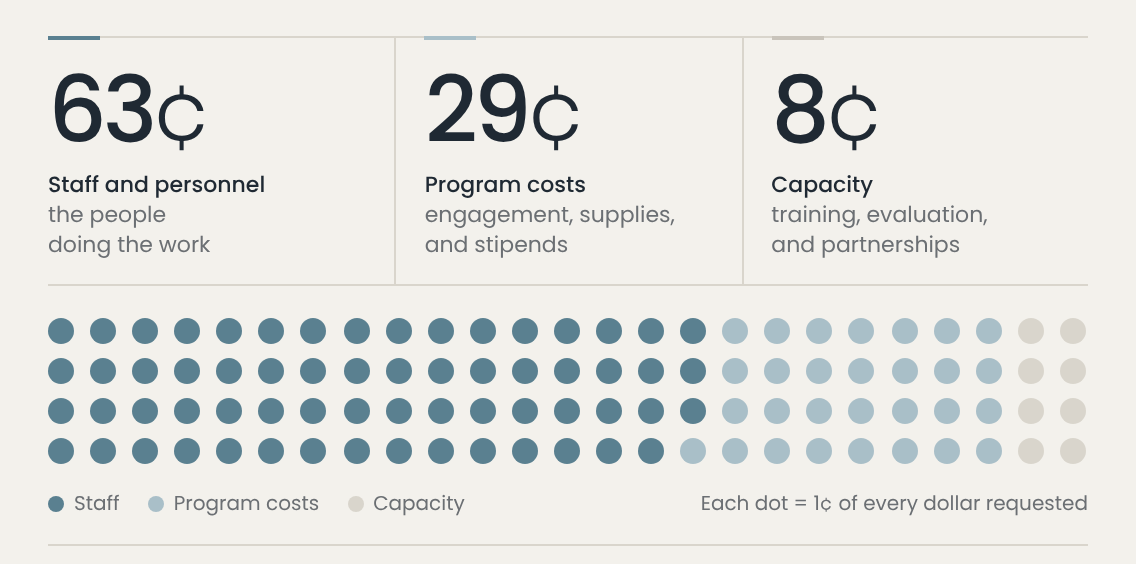
When organizations broke down what they were asking this fund to pay for, close to two of every three dollars went to staff. Youth and family engagement, program supplies, and stipends for young people made up most of the rest. Training, evaluation, and partnership costs together accounted for less than one dollar in ten.
That tells us that the scarcest resource in this work is not a curriculum or a building. It is the trusted adult, and the hours that adult can give.
It also showed up in a choice we asked every applicant to make. We asked organizations to describe what would change if they received their minimum request instead of their maximum. Many answered by narrowing their reach, meeting less often, or trimming extras, while protecting the relationship at the center of the work. One program would serve 26 young people instead of 35 and keep its staffing whole. Another would drop from five days a week to three while holding its mentor-to-youth ratio. Organizations are telling us, in a very practical way, what they believe matters most.
Some of the need is a gap someone else left
Several applicants described stepping into space that another institution recently stepped out of.
- An afterschool program is working to fill sites left when a longtime public partner ended its programming.
- A neighborhood center is opening on Fridays after cuts elsewhere left young people with nowhere to go.
- A family drop-in center took over operations on short notice so families experiencing homelessness would not lose their only daytime refuge.
These organizations are absorbing gaps in real time, often without designated funding to do it. That is resilience worth naming, and it is a signal worth watching.
Many programs are building pathways, not only prevention
This is violence prevention funding, yet a large share of the programs that advanced are also about what comes next for a young person:
- College and career advising with financial aid support
- Paid work experience and portfolio building
- Workforce readiness, financial literacy, credential and licensing goals
- A paid fellowship that brings justice-involved youth before decision-makers as advocates
Applicants are making a case that safety and opportunity are the same work.
A young person with a mentor, a plan, and a real next step is safer, and so is the community around them. That is the bridge between this fund and the Path to 70%: every one of these programs is, in part, building the road to a credential and a career.
Transitions matter
Some of the most focused proposals were built around a single moment of change: the months after probation ends, the first contact with juvenile court, the move into independent adulthood. These are the moments when support tends to fall away, and applicants are designing programs to make sure it does not.
The financial gap
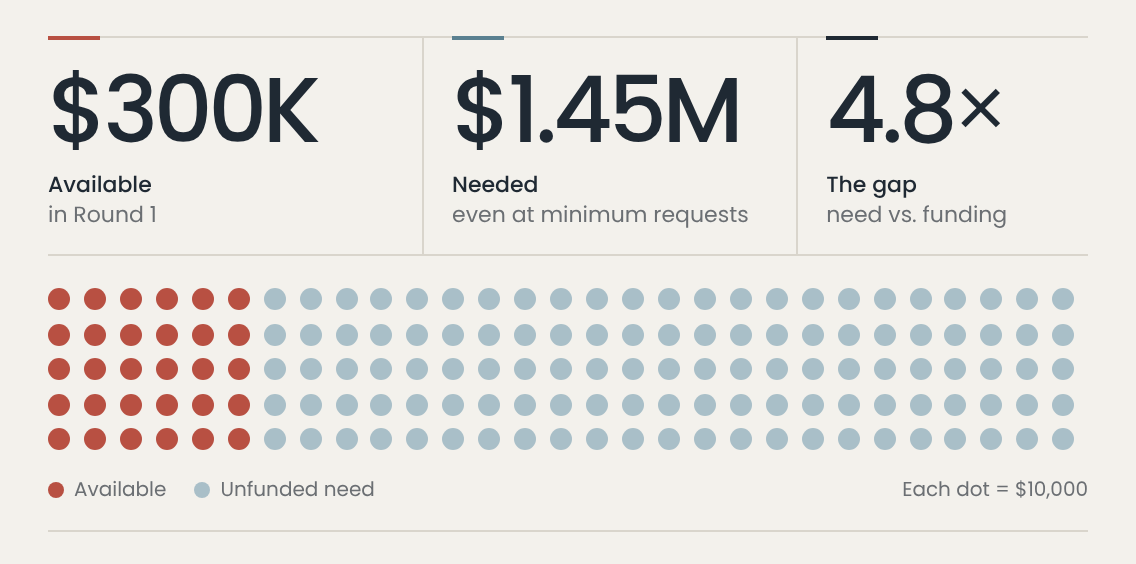
The Round 1 pool was $300,000. The minimum requests from the organizations that advanced to the budget phase added up to more than $1.4 million, close to five times what was available. At their maximum requests, the total was over $2.4 million, about eight times the pool. Even the full $700,000 available across all three rounds would cover less than half of what Round 1 applicants said they needed at minimum.
The gap holds even at the top of the list. The ten applications recommended for awards asked for $424,521 at their minimums. Awards ranged from $10,000 to $45,000, and seven of the ten received less than the smallest amount they said they could work with.
The gap is not a sign that organizations asked for too much. Most requests were carefully scoped and modest. Almost half of the organizations that advanced operate on annual budgets under $500,000, and for several, this grant would be a meaningful share of everything they run. These are lean organizations doing serious work.
What the gap tells us is that the will and the infrastructure to support Pierce County’s young people already exist in community. What is missing is sustained investment at the scale of the need.
What we are taking forward
Round 1 was a first look. Rounds 2 and 3 will add to the picture, and we will share what we learn. For now, three lessons stand out:
01
Invest in people.
The relationships at the center of this work are what organizations protect first, and what they need most.
02
Watch the gaps.
When one institution steps back, community organizations step in. Funders and public partners can help by noticing where that is happening.
03
Prevention and opportunity belong together.
The programs advancing in this fund are already building pathways to school and work. The more we align that work with education and workforce partners, the further each dollar goes.
The Local Advisory Team, the applicants, and the young people at the center of every proposal have given Pierce County a clear picture of where we stand. The question now is what we do with it, together.
Final applications are due Friday, October 16.Community Reinvestment Program, Round 3
Apply Now