Building Shared Accountability: Insights from Pierce County’s Leadership Tables

This spring, we closed our Partnership Summit with a commitment. After sharing the data behind our mission and the framework this community built together, we promised to convene a leadership structure to carry the work forward and to share what we learned along the way.

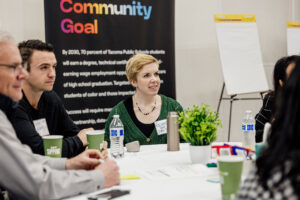
Leaders from across Pierce County came together last month to launch three Leadership Tables: Affordability, Navigation, and Workforce Readiness. Each table acts as a governing body charged with removing systemic barriers and aligning our strategic direction. These leaders are tasked with setting priorities and goals, providing transparent accountability, and guiding the broader Action Networks where practitioners execute the strategies

Every table worked through the same guiding question: what must be true 12 months from now for us to say this Leadership Table is actually governing regional progress toward 70% credential attainment?
What the Affordability Table Told Us

This table takes on the financial barriers that keep residents from completing a credential, focusing on regional Promise models and FAFSA/WASFA completion efforts.

Map the promise landscape first. Leaders committed to gathering data on existing Promise models and institutional financial aid packaging policies already active in Pierce County. The building blocks already exist, as seen with Clover Park Technical College’s Promise scholarship, which has grown from 20 to nearly 100 students. With the State Board for Community and Technical Colleges moving toward common aid policies, a unified Pierce County effort would accelerate this statewide direction.

Meet families where they are. Leaders called for reviving train-the-trainer models that equip trusted community members at libraries, cultural centers, and community-based organizations to act as FAFSA/WASFA experts. They also highlighted the need to build tailored, multilingual support for families and targeted messaging for adult learners, two critical groups our current systems often leave behind.

Hands-on support works: Technology access remains a significant barrier for FAFSA completion. Close, walk-through support with students and families, in partnership with school support staff, is necessary to achieve high completion rates.

What the Navigation Table Told Us

Because K-12 and postsecondary systems are often misaligned by design, students can get lost across the entire spectrum. This table focuses on clearing the path from high school through postsecondary completion.

The drop-off happens everywhere: Two-thirds of Pierce County’s opportunity youth, those who are out of school and work, already hold a high school diploma. Because students float between disjointed systems, leaders called for funding a county-wide opportunity assessment to map exactly where students get lost and where support currently exists 

Money alone won’t hold students: Leaders were clear that any future Promise effort must be more than just a scholarship. It needs to function as a navigation vehicle with multiple entry points, recognizing that identity and belonging matter well beyond tuition coverage. 

Speak a common language: Terms like dual credit, Running Start, CTE, and Honors mean different things depending on the institution. Leaders called for a shared regional glossary and plain, inclusive language so families know exactly what they qualify for.

What the Workforce Readiness Table Told Us

A credential earns its value when it leads to a career with a livable wage. This table connects credentials to careers by prioritizing high-demand sectors and improving pathways.

Build shared visibility: Leaders committed to creating a shared database of what every organization offers to support credential attainment. This ensures the region builds on existing work, providing mutual visibility that explicitly includes credential providers outside of traditional colleges. 

Bring employers deeper into the work: Employers receive educated workers, but they are not actively shaping and supporting the system that produces them. One local paper mill, facing a wave of retirements, successfully funded a grant to train young people for placements. Leaders identified stronger alignment with workforce partners and a coalition of industry voices as a 12-month priority. 

Define “credential” together: The region needs a clarified, shared, and outwardly communicated definition of a “credential” that industry actually recognizes as proof someone can do the work.

Themes for Regional Success

Across all three tables, several unifying themes emerged that will define our collective success over the next year:

  • Shift the burden. All three tables explicitly named the need to shift systemic navigation burdens off the shoulders of students and families. These burdens must be placed back onto the systems built to serve them in a way institutions can own and sustain. 


  • Map before you build. Leaders committed to assessing current packaging policies, conducting county opportunity assessments, and pooling organizational offerings so we build upon existing models rather than starting from scratch. 


  • Expand the table. Critical voices must hold a formal seat in these conversations, including employers, four-year institutions, and the smaller community-based organizations doing grassroots work with high-barrier populations. 


  • Acknowledge capacity constraints: Shrinking counselor positions, financial aid staffing, and community-organization funding are actively undermining the hands-on support that demonstrably works.

Looking Ahead

Honesty is a strength of this work, and leaders brought it. Some came with a fair question: we have been here before, and we have a lot of tables. We welcome that candor, because it names exactly what these convenings must become instead: measurable targets, clear responsibilities, and barriers removed inside institutions.

Leaders were candid about capacity, too. The room welcomed the recent statewide momentum on financial aid, alongside a clear-eyed reminder: policy delivers when trusted people stand beside students and families to act on it.

This fall, the Action Networks begin convening and the tables set their first shared targets. Then, on October 21, we return to where this started. The Fall Partnership Summit brings the work back to the community that shaped it: the progress since March, the goals and commitments taking form, and an invitation into what comes next.