One of the most powerful things about the EdCollaborative’s inaugural summit was hearing leaders from across sectors describe the same system from entirely different vantage points and arrive at remarkably similar conclusions.
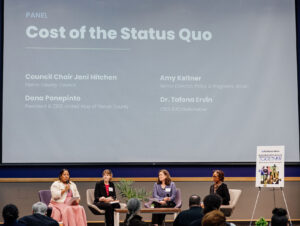
During two panel conversations, six leaders from county government, state policy, community services, K-12 education, higher education, and workforce development shared what they’re seeing from where they sit. No one had a complete picture and that was the point. What emerged was a shared understanding of where the system is working, where it falls short, and what it will take to move forward together.
Here’s what they told us.
Students don’t experience systems. They experience relationships.
Amy Keltner, Senior Director of Policy and Programs at the Washington Student Achievement Council, reframed the conversation early. The strategy at the state level focuses on affordability, enrollment, completion, and basic needs, but none of that matters if we lose sight of the student’s actual experience. Students and families don’t navigate structures. They navigate relationships and a journey. And there are specific moments along that journey where they’re most likely to disengage: before they’ve built a personal vision for what comes next, when basic needs force impossible trade-offs, or when they begin to question whether the investment will actually lead somewhere.
Lance Goodpaster, Superintendent of Franklin Pierce School District, echoed this from inside the K–12 system. What students need most, he said, is a trusted adult, starting early and continuing through every transition. But the landscape of postsecondary options in Pierce County has grown so complex that even the adults in the system don’t always fully understand how to help students navigate it. The work has to start with equipping the people closest to students with the knowledge and tools to guide them.
Basic needs are the foundation, and the foundation is unsteady.
Dona Ponepinto, President and CEO of United Way of Pierce County, brought the room into the daily reality of ALICE families: asset limited, income constrained, employed. These are families doing everything they can and still unable to make ends meet. She named the barriers that rarely appear in our charts. The benefits cliff that penalizes families for improving their income. The housing instability that creates stress, isolation, and health consequences. The food insecurity that continues to grow across our communities.
What stood out was her insistence that behind every data point is a family navigating systems that weren’t designed to work together. United Way’s experience with direct cash assistance, $500 a month for three years, showed what happens when families have even modest breathing room. Children participated in extracurricular activities. Household stress decreased. Kids did better in school. Those outcomes don’t always show up in our traditional metrics, but they shape whether a young person can even begin to envision a path toward a credential.
Amy Keltner added statewide context: half of Washington’s college students report housing or food insecurity, three out of four parenting students cannot afford childcare, and more than half of eligible students don’t access the benefits available to them. The supports exist. The ability to navigate to them often does not.
Local investment requires public will, and public will requires honesty.
Council Chair Jani Hitchen was direct. Pierce County has tools available for local investment, including the potential for a levy dedicated to children and family services. But using those tools requires political will, and political will requires a community willing to ask hard questions openly rather than hedging around them. Local control, she emphasized, means the community decides where dollars go: which gaps to close, which populations to prioritize, which barriers to eliminate.
Public will drives political will. The leaders in the room see these challenges every day. The broader community often does not. Building the public understanding necessary to sustain large-scale investment means lifting up lived experience and making the case in ways that everyday residents can see themselves in.
Dr. Sheila Edwards Lange, Chancellor of UW Tacoma, brought The Promise program conversation into sharper focus. Having helped develop the Seattle Promise during her time at Seattle Colleges, she offered candid guidance: before designing a promise program, a community has to align on what it’s trying to achieve. Is the goal broad access? Serving historically underserved populations? Supporting recent graduates or returning adults? Where can students take the promise, to community college only or beyond? These design questions are deeply political, and not everyone will agree. The key is to start with the goal and design around it, knowing that perfect consensus isn’t a prerequisite for meaningful action.
The ecosystem is richer than we realize, and employers need to be part of it.
Katie Condit, President and CEO of Workforce Central, brought the employer perspective that was notably underrepresented in the room. The word she kept returning to was reciprocity. Employers aren’t separate from the education and social service ecosystem. They’re part of it. And many of them, she said, simply don’t know what exists. At a recent economic development luncheon, 400 business leaders expressed surprise that Pierce County has nine colleges and active manufacturing training programs.
She offered a concrete example of what coordination looks like when it works. The City of Tacoma, facing a wave of civil engineer retirements, partnered with Degrees of Change and higher education to create a targeted training pipeline. Not hundreds of people, but two cohorts of twenty, with a commitment to employment on the other side. That kind of localized, relationship-driven problem solving is the model.
Katie also issued a caution the room needed to hear. She described a statewide initiative that invested millions in launching new workforce training programs without first mapping what already existed. Up to half of those programs have since closed. It may take longer to align strategy with existing assets, but it has far more staying power. Pierce County is resource-rich. The work is not to build from scratch but to connect what’s already here with greater intention.
What this tells us.
Across both panels, a clear thread emerged. The people doing this work are not short on commitment or expertise. What’s been missing is the connective tissue, the sustained infrastructure that allows leaders across sectors to see the same landscape, coordinate at transition points, and hold each other accountable to shared goals.
Every panelist, in their own way, described a version of the same insight: we are program-rich and system-poor. The path forward isn’t more programs. It’s better coordination, small, intentional, sustained, and built on the relationships and assets this community already has.