The EdCollaborative didn’t come to the summit with a finished plan. We came with a starting point and an honest question: does this framework reflect what you’re seeing, and what would you change?
The answer, surfaced through two group exercises and more than 140 voices across sectors, gave us something no single organization could have produced alone. It confirmed much of what we proposed, challenged us where we needed it, and added layers of insight that will shape everything that comes next.
Here is the framework we shared, what the community told us, and where we go from here.
The Framework

The EdCollaborative Planning Framework is organized around three questions. Where are we now? Where do we want to be? And how do we get from here to there?
The current reality includes what the data tells us: 45% credential attainment in Pierce County, FAFSA completion gaps, navigation breakdowns at key transition points, and roughly 14,000 disconnected young adults.
The north star is 70% credential attainment, grounded in labor market projections showing that 72% of living-wage jobs in Washington will require postsecondary education or training.
The pathway to action is organized around three focus areas: affordability, navigation, and workforce readiness.
We presented this framework not as a conclusion, but as a proposal. The room’s job was to pressure-test it, push back where needed, and add what was missing.
Current Reality
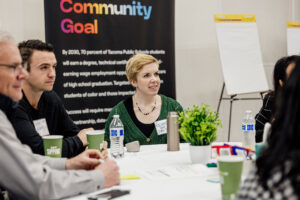
In the first exercise, tables examined the landscape and shared where students are falling through, and what’s working that we should build on. Several themes emerged consistently.
The first was around transitions. Multiple tables observed that our systems tend to function well within themselves. Students can thrive in K-12. They can thrive in higher education. But the handoff between systems is where the pipeline breaks.
Tables pointed to dual enrollment and Running Start as mechanisms that are already working to blur those lines, while also noting that access to these programs is uneven across districts and populations.

The second theme was family engagement. Across nearly every table, participants raised the importance of meeting families where they are, understanding the external pressures that pull students away from school, and designing supports that address the whole family, not just the student.
Several tables raised two-generation approaches that invest in parents alongside their children.
The third was a call for youth voices, but with an important distinction. Young people need to be at the table, not to fix a system they didn’t create, but to inform how solutions get designed. Their perspective is essential for ensuring that what we build actually makes sense in the context of their lives.
Tables also identified critical voices still missing from the conversation: employers and businesses, tribal organizations, organized labor, childcare providers, faith communities, and teachers currently in the classroom.
Pathways to Action
The second exercise shifted from diagnosis to direction. Tables were asked three questions across affordability, navigation, and workforce readiness: what exists now that we can build on, what needs to change systemically, and what would you do if resources were guaranteed?
Multiple tables called for an asset map with a clear inventory of who is doing what, with which populations, and at what stages of the pipeline.
Several tables raised the idea of micro-cohort training pipelines. Small, targeted partnerships between employers and education institutions designed around specific workforce needs. The example of the City of Tacoma partnering to train its next generation of civil engineers resonated as a model for what localized, relationship-driven problem solving looks like.
There was significant energy around a dedicated local funding mechanism, such as a levy for children and family services, and what the organizing process around that could unlock for the community.
When we asked partners to “dream a little,” the room went to some powerful places. Universal access to pre-K so every child enters kindergarten ready to learn. Education reframed as a public good, not just a workforce pipeline. A shared commitment to raising young people with a strong sense of agency who are invested in their community.
Looking Ahead
The themes from both exercises are now shaping the next phase of this work. Over the coming months, the EdCollaborative will organize leadership tables and action networks around affordability, navigation, and workforce readiness.
By fall, we aim to reach agreement on specific strategies with clear timelines, committed partners, and shared accountability.
This framework belongs to the community that shaped it. We brought a starting point. You made it real. And we’re just getting started.